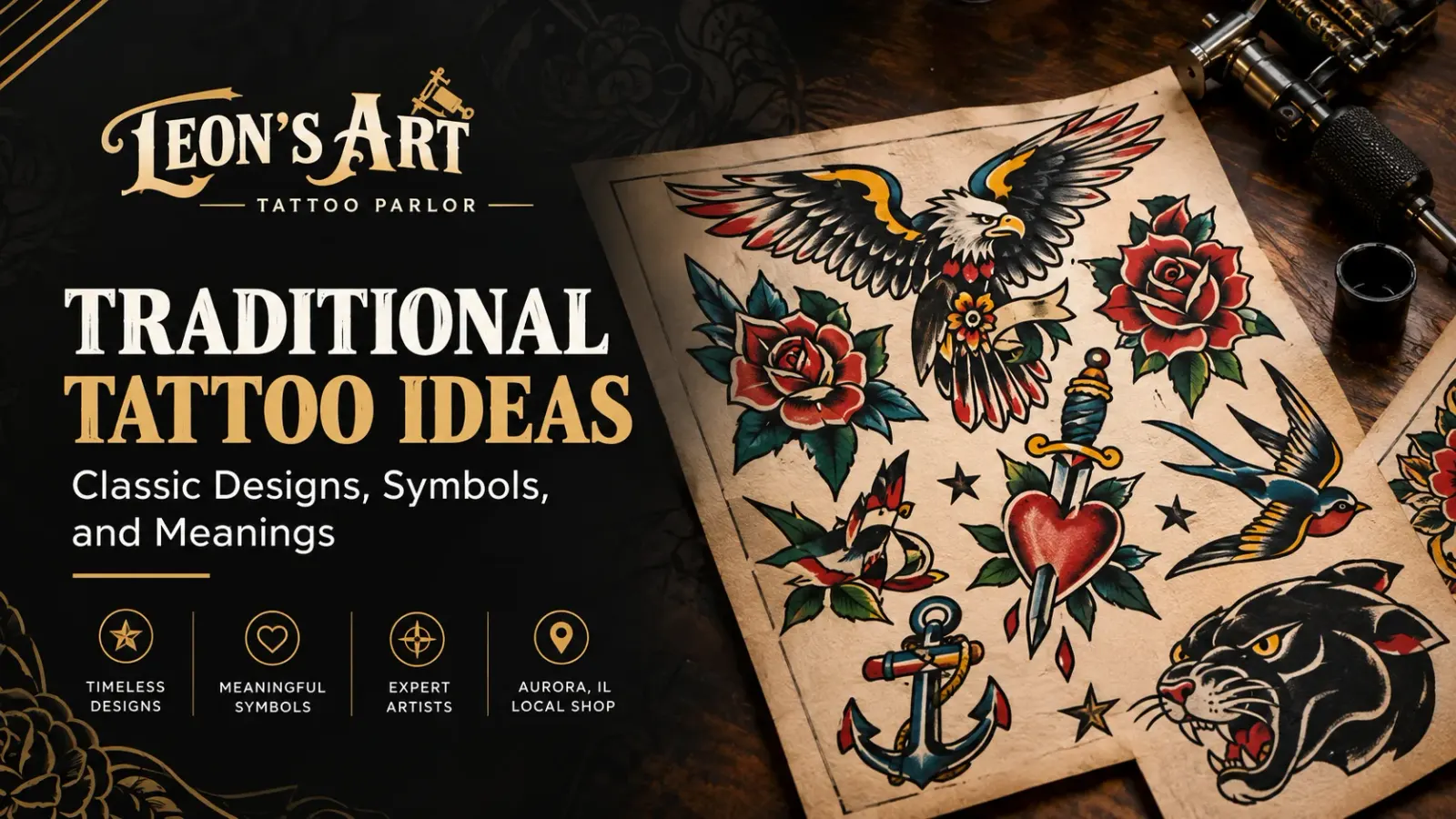
Traditional Tattoos
Traditional Tattoo Ideas: Classic Designs, Symbols, and Meanings
Explore traditional tattoo ideas, from roses and eagles to daggers, swallows, and anchors. Discover classic meanings, placements, and design tips.
What traditional tattoos are known for
Traditional tattoos are known for their bold black outlines, vibrant colors, and timeless designs. From classic roses and powerful eagles to anchors, daggers, and swallows, these tattoos combine distinctive artwork with symbolism that can reflect personal experiences, values, and memories. Understanding the meanings behind popular symbols, exploring different placements, and choosing the right color palette can help you find a design that suits your style. At Leon’s Art Tattoo Parlor in Aurora, Illinois, you can explore tattoo ideas and consider how a classic design might fit your vision.
What are traditional tattoos?
Traditional tattoos, particularly American traditional tattoos, are recognized for bold outlines, solid colors, strong contrast, and simplified imagery. The style developed through a long history of tattooing, with maritime influences and artists who helped establish the recognizable American traditional aesthetic. Common subjects include roses, eagles, anchors, swallows, daggers, skulls, snakes, panthers, and sailing ships. These designs often use a limited color palette and clearly defined shapes. Unlike photorealistic tattoos, which aim to recreate the appearance of real subjects, traditional tattoos emphasize stylized illustrations and recognizable forms. American traditional tattoos generally use heavier outlines, simpler shapes, and a more limited color palette. Neo-traditional designs often introduce more elaborate details, dimensional shading, additional colors, and decorative elements. For example, a traditional rose may feature solid red petals and bold black outlines, while a neo-traditional rose may incorporate layered shading and more intricate color transitions.
Key characteristics
Several features define this classic style, and the size and complexity of a design should still be planned carefully for the placement.
Bold outlines, color, and contrast
Bold black outlines create clear boundaries around the design. Red, yellow, green, blue, and black are frequently used. Simple, recognizable shapes keep the main subject visually distinct, and high contrast helps separate details. Familiar motifs give the style its enduring appeal.
12 popular traditional tattoo ideas
Traditional tattoo symbols can carry historical, cultural, and personal significance. Their meanings are not universal, so use these interpretations as inspiration rather than strict definitions.
Traditional Rose Tattoos
Rose tattoos are among the most recognizable traditional designs. Their layered petals and contrasting colors make them a natural fit for the style. Common meanings include love, beauty, passion, remembrance, and appreciation. Popular ideas include a single red rose, a rose with green leaves, a rose combined with a dagger, or a rose with a banner containing a name or meaningful date. A rose can stand alone or become part of a larger sleeve.
Traditional Eagle Tattoos
Eagle tattoos create a powerful visual statement through their wings, feathers, and strong silhouettes. Common meanings include freedom, strength, courage, independence, and determination. Design options include an eagle in flight, an eagle with a banner, or a large eagle positioned across the chest or upper arm. Because the wings can require considerable space, discuss the intended size and placement before finalizing the design.
Traditional Anchor Tattoos
Anchors are classic maritime symbols that remain popular in traditional tattooing. Common meanings include stability, loyalty, hope, grounding, and perseverance. A traditional anchor can be paired with a rope, rose, banner, or nautical star, or it can stand alone. The forearm, upper arm, and calf may suit anchor tattoos, depending on the composition and desired size.
Traditional Swallow Tattoos
Swallows have a long association with maritime tattoo imagery and the idea of returning home after a journey. Common meanings include loyalty, travel, hope, freedom, and homecoming. A single swallow can create a compact design, while a pair can provide a balanced composition. Some people also incorporate flowers, stars, or banners. Choose a placement that allows the bird’s wings and tail to remain clearly defined.
Traditional Dagger Tattoos
Dagger tattoos are recognized for their strong lines and dramatic appearance. Common meanings include courage, protection, conflict, sacrifice, and resilience. Popular combinations include a dagger piercing a rose, a dagger with a heart, or a snake wrapped around a blade. The elongated shape often suits the forearm or calf. Your artist can help determine the right size and orientation.
Traditional Snake Tattoos
Snakes are versatile subjects because their bodies can curve, coil, and wrap around other tattoo elements. Common meanings include transformation, renewal, wisdom, danger, and protection. A snake can be combined with a dagger, skull, or floral design, or arranged in a flowing composition on its own. Consider the direction of the snake’s movement and how the design will follow the contours of the placement.
Traditional Panther Tattoos
Traditional panther tattoos are known for dramatic expressions, strong silhouettes, and bold black shading. Common meanings include power, confidence, independence, and resilience. A panther can be illustrated as a full animal, a walking figure, or a close-up head design. Larger placements may allow more room for the details that make the artwork recognizable. Discuss the amount of dark shading and the composition so the design suits the available space.
Traditional Heart Tattoos
Heart tattoos can express personal connections through simple, recognizable imagery. Common meanings include love, family, devotion, friendship, and remembrance. Traditional heart designs may include red coloring, banners, names, flowers, flames, or decorative elements. If you want lettering, consider the length of the text and the size needed to keep it readable. A simple heart can work as a small tattoo, while a more elaborate composition may require additional space.
Traditional Skull Tattoos
Skulls are popular in traditional tattooing because they offer strong shapes and opportunities for contrasting details. Common meanings include mortality, remembrance, change, and fearlessness. Designs may feature skulls with roses, daggers, decorative hats, or other classic motifs. A skull can stand alone or serve as the central subject of a larger composition. The size should allow important features, such as the eye sockets and teeth, to remain distinguishable.
Traditional Ship Tattoos
Traditional sailing ships are associated with maritime history and the experience of navigating uncertain journeys. Common meanings include adventure, perseverance, travel, and independence. A ship tattoo may show sails against the wind, waves beneath the hull, or decorative elements inspired by maritime imagery. Larger placements can accommodate the sails and other details. If you prefer a smaller tattoo, ask whether the composition can be simplified.
Traditional Tiger Tattoos
Tiger tattoos are known for their striking stripes, expressive faces, and bold visual character. Common meanings include strength, courage, determination, and power. A traditional tiger may be depicted as a head, a full animal, or a dynamic figure surrounded by other elements. The upper arm, shoulder, and thigh can offer room for larger designs. For a smaller tattoo, a simplified composition may work better than one with excessive detail.
Traditional Nautical Star Tattoos
Nautical stars are recognizable geometric motifs associated with navigation and maritime imagery. Common meanings include direction, guidance, hope, and finding one’s way. A nautical star can stand alone or accompany anchors, ships, and swallows. Its symmetrical form makes it adaptable to several placements. If you are adding it to an existing collection, consider how its size and position will complement the surrounding artwork.
Traditional tattoo combinations
Combining traditional motifs can create a design with more personal significance while preserving the style’s recognizable appearance. Names, dates, and short phrases can also personalize traditional designs. Before the tattoo session, verify every letter and number and review the placement and lettering size.
Rose and dagger
A rose and dagger create a contrast between floral imagery and a sharp, dramatic subject. The combination may represent love, hardship, courage, or overcoming challenges.
Eagle and banner
An eagle paired with a banner can create a bold design. A banner may contain a name, short phrase, or date that carries personal meaning.
Snake and skull
A snake and skull combination can explore themes of transformation, mortality, danger, or resilience. The snake can wrap around the skull or frame it within the composition.
Heart and banner
Heart-and-banner tattoos are often chosen to commemorate relationships, family connections, or meaningful memories. Keep the wording concise and ensure it has enough space to remain readable.
Panther and floral
Flowers can complement a traditional panther by balancing its powerful appearance with softer shapes and contrasting colors. The artist can arrange the elements so the main subject remains prominent.
Best placements for traditional tattoos
The best placement depends on the design’s size, shape, detail, visibility, and how it fits the body’s contours.
Forearm, upper arm, and shoulder
The forearm can accommodate roses, daggers, anchors, snakes, and hearts. Longer designs may suit its shape, while compact motifs can work in smaller areas. The upper arm and shoulder offer room for eagles, panthers, roses, and skulls, and they can work well if you plan to add more tattoos later.
Sleeves and chest
A traditional sleeve combines multiple designs into a coordinated composition across the arm. Common elements include roses, daggers, panthers, hearts, skulls, and swallows. The chest can accommodate larger designs and broad compositions, including eagles and ships. Consider how the design will follow the body’s contours.
Leg, calf, and small designs
The calf can suit elongated subjects such as daggers and snakes, while the thigh may provide more space for larger roses, tigers, or skulls. Small traditional tattoos can work for compact hearts, stars, anchors, and roses. Not every design works well at a small scale, so discuss the appropriate size before choosing tiny lettering or excessive detail.
Color and black-and-grey traditional tattoos
Traditional tattoos are often associated with saturated colors, but the style can also be adapted to black-and-grey artwork. Red, yellow, green, blue, and black are common colors in American traditional designs, and they can help distinguish different elements. Black-and-grey designs use outlines, shading, and negative space rather than a full color palette. This option may suit people who prefer monochromatic artwork or want a new tattoo to complement existing black-and-grey pieces. The design still needs enough contrast to keep its main features distinct. Consider your preference, the complexity of the design, the placement, and how the tattoo will work with your existing collection.
How to choose the right traditional tattoo
Choosing a tattoo is a personal decision. Think about what attracts you to a particular motif, whether that is its appearance, its common symbolism, or a personal experience. A tattoo does not need a deep symbolic meaning to be worthwhile. Match the design to the placement: an eagle with extended wings may need more width than a dagger, while a snake may benefit from an area that accommodates its curves. Give the design enough space for its important features. Smaller tattoos often benefit from simpler compositions. Bring reference images to explain the subjects, colors, lettering, and compositions you like, and also explain what you do not want. Discuss the design, placement, size, color palette, expected session time, and price before the appointment.
How traditional tattoos have evolved
Traditional tattooing has developed through many influences, including maritime culture, traveling tattoo artists, and the use of tattoo flash sheets. American traditional tattooing became associated with bold outlines, limited color palettes, and familiar subjects such as ships, anchors, roses, eagles, and swallows. Modern tattoo artists continue to reinterpret these classic motifs. Some stay close to traditional conventions, while others introduce different color choices, compositions, and decorative details. People choose traditional tattoos for their historical associations, bold appearance, personal symbolism, or enduring artistic style.
Traditional tattoos in Aurora
If you are exploring traditional tattoo designs, the next step is finding an approach that suits your preferences and intended placement. Leon’s Art Tattoo Parlor in Aurora, Illinois, is a local option for people researching tattoo styles and planning their next piece. Whether you are considering a classic rose, eagle, dagger, snake, or larger traditional composition, take time to explore your ideas. Before booking, discuss your concept with the shop, review relevant artist portfolio examples, and ask about available design options. From a simple rose or anchor to a detailed eagle, panther, or traditional sleeve, choose a tattoo that reflects your preferences and work with your artist to plan a design you will be happy to wear.
Frequently asked questions
A traditional tattoo usually refers to a classic style, particularly American traditional tattooing, characterized by bold black outlines, strong contrast, simplified shapes, and often saturated colors. Common subjects include roses, eagles, anchors, swallows, daggers, and skulls.
Traditional tattoo symbols have many common interpretations. Roses may represent love or remembrance, anchors can symbolize stability, and swallows are often associated with travel and homecoming. Meanings vary by individual and cultural context.
Popular designs include roses, eagles, anchors, swallows, daggers, snakes, panthers, hearts, skulls, ships, tigers, and nautical stars. They can be used individually or combined into larger compositions.
They can be suitable if you enjoy the style and choose a design that fits your preferences. Discuss the size, placement, detail, and aftercare with your tattoo artist before making a decision.
Bold outlines, strong contrast, and recognizable shapes can help traditional tattoos remain visually clear. However, their appearance can change over time due to sun exposure, skin changes, placement, ink, technique, and aftercare.
No. Although classic American traditional tattoos often use saturated colors, traditional-inspired artwork can also be created in black and grey.
The best placement depends on the design’s shape, size, and detail. The forearm and calf may suit elongated motifs, while the upper arm, shoulder, chest, and thigh can accommodate many larger compositions.
Pricing depends on size, complexity, placement, artist, and session time. Contact your tattoo shop with your idea to discuss the expected cost before booking.
Yes. Artists can personalize traditional designs through subject selection, composition, colors, banners, lettering, and additional motifs while retaining the style’s recognizable visual characteristics.
You can explore Leon’s Art Tattoo Parlor in Aurora, Illinois, as a local option. Visit the studio site to learn more and contact the shop about your design and booking options.
For questions about a tattoo idea, contact the studio to discuss your project and next steps.
Contact the studio